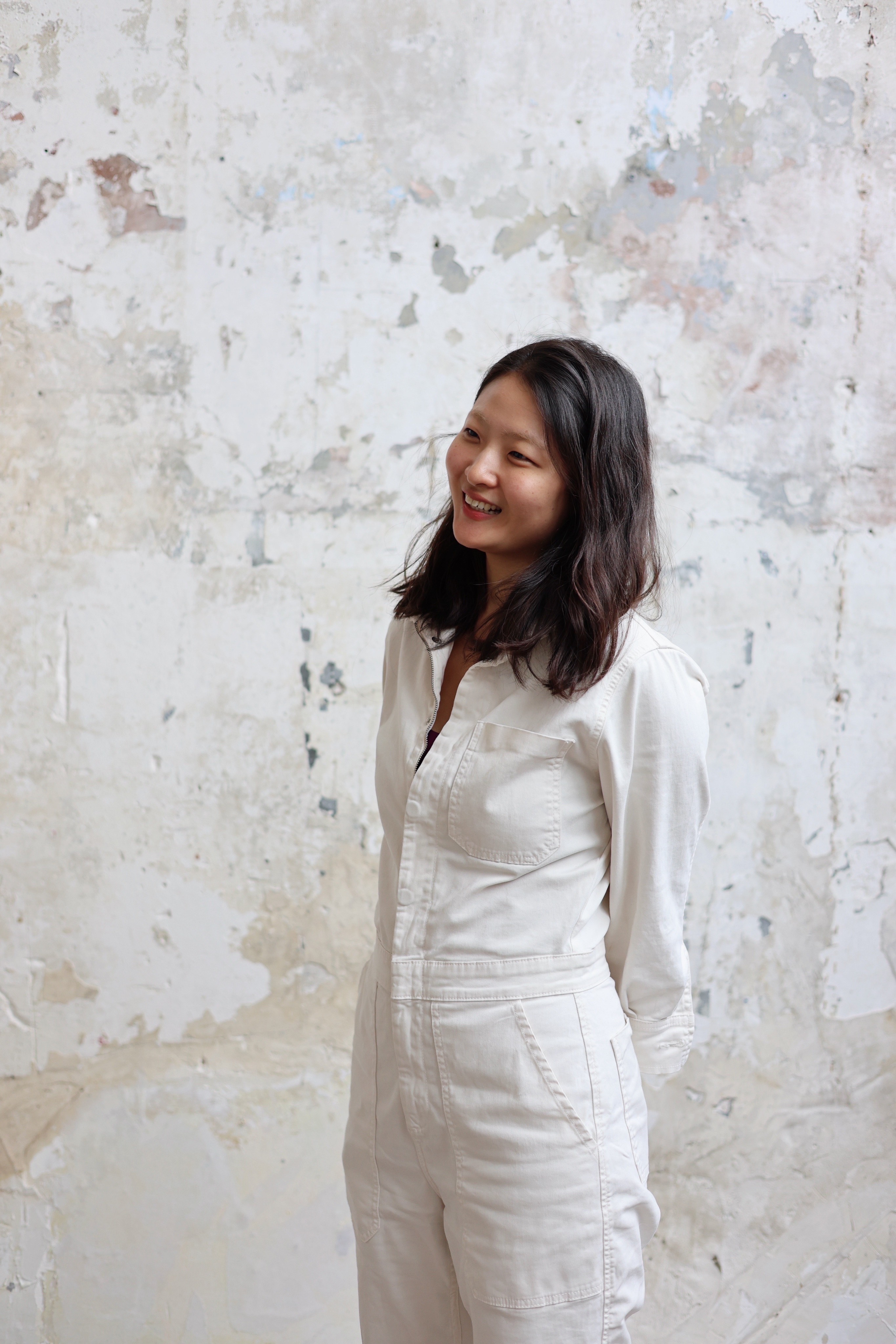
L'AiR Arts, Paris, France. 2025 September.
About
My practice observes how materials hold, carry, and release memory across different speeds of time and distinct environments, whether familiar or foreign. Working between painting, sculpture, installation, ceramics, glass, flowers, fibers, found objects, and bio-based matter, I approach materials not only as vessels of memory, but as conditions through which the body moves, senses, and changes.
I am interested in the moment when a material stops being an object and becomes an environment: when a painting extends beyond the surface, when a sculpture behaves like a room, when a flower, fabric, smell, pigment, or sound alters the way a viewer breathes, walks, or remembers. My work often takes the form of temporary environments—fragile, atmospheric, and site-responsive—where memory is not represented as an image, but entered as a passage.
Whether I am mixing paints from natural pigments and red algae binders, melting glass, working with beeswax, cooking starch-based bioplastics, gathering flowers, or capturing surrounding elements through alternative photographic processes, I am engaged in a constant negotiation between what is frozen, what is melting, what is decaying, and what is being transformed.
My bioplastic sculptures embody decaying and durational time. Cooked from local grains, starches, and plant-based ingredients, these forms carry personal and geographical stories in their chemistry. They are accessible yet unstable, designed to warp, soften, crack, or shift over time. Their vulnerability resembles the malleability of human memory: never fixed, always re-forming in relation to climate, touch, and place.
My experimental photography captures light-speed, momentary time: a split second imprinted by chemistry, exposure, and chance. Often made with found or prepared elements, these images act less as documents than as residues of encounter. In some works, beeswax is layered onto photographs like skin, creating a tactile membrane between image and memory, visibility and concealment.
Glass holds both cyclical and frozen time. Like glacier ice or bioplastic, it traps air bubbles—archives of breath from the moment of making—within a solid yet fragile body. Although glass appears fixed, it remains materially open to transformation. With heat, breath, and pressure, it can flow again, becoming another shape in another time.
My paintings are maps of earth, sea, and movement. I create them from scratch using pigments I have extracted, collected, or encountered during my travels, combined with natural binders I cook with red algae. These colors hold the memory of minerals, plants, and places, while the surfaces carry the physical trace of their making: stains from studio floors, accidental seepage through canvas or paper, waxy skins, sedimented textures, and gestures shaped by the body’s movement around the work.
I approach my studio practice as a form of cooking, ritual, and material research. Just as I mix paints with historical binders, I cook bioplastic forms using local ingredients that carry personal and collective histories. Through this process, I feel memory forming as texture: the fading orange of Oaxacan cempasúchil, the mineral depth of malachite, the translucency of wax, the trapped breath inside glass, the slow collapse of organic matter.
My work becomes material memory: a temporary archive of what we hold, release, and transform. It is a practice of making environments for constant flux—spaces where viewers are invited not only to look, but to enter, sense, and pass through the fragile material conditions of memory.
Teaching
I founded Material Memory Studio as an extension of this practice—a space for hands-on material research shared with others. Workshops invite participants to explore botanicals, pigments, binders, wax, fibers, and bio-based materials as carriers of personal and collective memory, approaching them not as neutral tools, but as living archives of place, time, and transformation. Currently open for botanicals.
한국어
나는 서로 다른 시간의 속도와 낯선 혹은 익숙한 환경 속에서 재료가 기억을 품고, 운반하고, 놓아주는 방식을 탐구하는 작가이다. 회화, 조각, 설치, 도자, 유리, 꽃, 섬유, 발견된 사물, 바이오 기반 재료를 넘나들며, 재료를 단순한 기억의 그릇이 아니라 관객의 몸이 통과하고 감각하며 변화하는 조건으로 다룬다.
내 관심은 재료가 오브제를 넘어 하나의 환경이 되는 순간에 있다. 회화가 표면 밖으로 확장될 때, 조각이 방처럼 작동할 때, 꽃과 천, 냄새, 안료, 소리가 관객의 호흡과 걸음, 기억의 방식을 바꿀 때, 작업은 더 이상 바라보는 대상에 머물지 않는다. 내 작업은 종종 임시적이고 장소 반응적인 환경의 형태를 띠며, 그 안에서 기억은 이미지로 재현되는 것이 아니라 몸으로 들어가고 통과하는 경험이 된다.
천연 안료와 홍조류 바인더로 물감을 만들고, 유리를 녹이고, 밀랍을 다루고, 전분 기반 바이오플라스틱을 요리하고, 꽃과 식물성 재료를 수집하며, 대안 사진의 화학적 과정을 통해 주변 환경을 기록하는 나의 실천은 얼어붙는 것, 녹아내리는 것, 부패하는 것, 그리고 변형되는 것 사이의 끊임없는 협상이다.
각 재료는 서로 다른 시간성을 지닌다. 바이오플라스틱 조각은 부패하고 지속되는 시간을 품으며, 시간이 지나며 휘어지고 갈라지고 부드러워지는 과정을 통해 유동적인 인간 기억을 닮아간다. 실험 사진은 빛과 화학, 우연에 의해 각인된 찰나의 시간을 붙잡고, 그 위에 겹쳐지는 밀랍은 이미지와 기억, 드러남과 감춤 사이의 피부 같은 막이 된다. 유리는 순환적이면서도 얼어붙은 시간을 지닌다. 유리 속 공기방울은 제작 순간의 숨결을 간직한 아카이브이며, 단단하지만 열과 호흡, 압력에 의해 다시 흐를 수 있는 가능성을 품는다.
내 회화는 대지와 바다, 이동의 지도이다. 여행 중 직접 채집하거나 추출한 안료와 홍조류로 만든 천연 바인더를 사용해 색을 만들고, 그 색은 광물과 식물, 장소의 기억을 품는다. 표면에는 작업실 바닥의 흔적, 캔버스와 종이를 통과해 스며든 색, 밀랍의 피부, 침전된 질감, 그리고 몸의 움직임이 남긴 제스처가 축적된다.
나는 작업실에서의 실천을 요리이자 의식, 물질 연구의 과정으로 접근한다. 역사적 바인더로 물감을 만들고, 지역 재료로 바이오플라스틱을 조리하며, 식물과 광물, 꽃과 밀랍, 유리와 섬유를 결합하는 과정 속에서 기억이 질감으로 형성되는 순간을 감각한다. 오악사카의 셈파수칠이 남기는 희미한 주황, 말라카이트의 오래된 녹색, 밀랍의 반투명한 막, 유리 속에 갇힌 숨, 유기물이 천천히 무너지는 시간은 모두 내 작업 안에서 물질적 기억이 된다.
내 작업은 우리가 품고, 놓아주고, 변형하는 이야기들의 임시적 아카이브이다. 나는 끊임없이 변화하는 재료의 조건을 통해 관객이 기억을 바라보는 것이 아니라, 만지고, 냄새 맡고, 들어가고, 통과할 수 있는 감각적 환경을 만든다.
From the Studio
Occasional letters on new work, exhibitions, and the materials that carry memory.
By subscribing, you agree to our Privacy Policy.